Sector: BIM & 3D data · Consorzio Metis
Scan-to-BIM pipeline: from point cloud to IFC model
Pipeline converting laser-scanner point clouds into BIM models: scan registration, E57 processing, controlled decimation and automated conversion to IFC through Python.
- E57 → IFC
- Flow
- Python
- Automation
- Millions of points
- Data
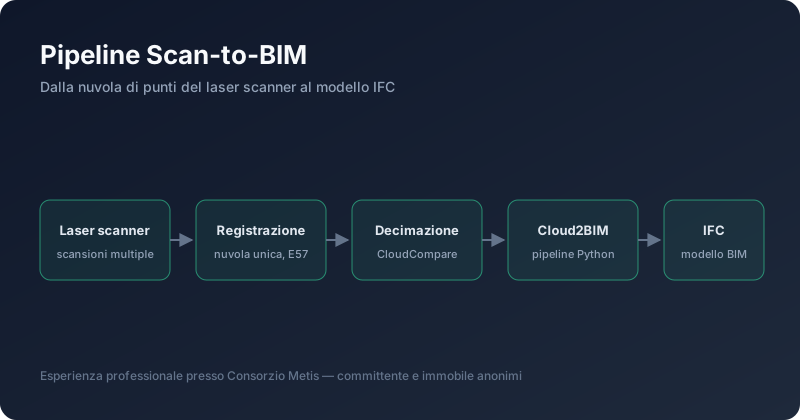
Professional experience as an employee at Consorzio Metis. Client and building are not identifiable; specific numeric parameters and working paths have been omitted.
Context
Laser-scanner surveys produce extremely dense, reality-faithful point clouds, but designers work on BIM models: building elements (walls, slabs, openings) with semantics, not millions of coordinates. Getting from one to the other — Scan-to-BIM — is traditionally manual and expensive. This pipeline automates as much of it as possible.
The pipeline
- Acquisition: multiple scans of the building with a laser scanner.
- Registration: aligning the scans into a single coherent cloud, exported in E57 format.
- Decimation: controlled subsampling with CloudCompare to bring the cloud to a manageable density without losing the required geometric accuracy.
- Automated conversion: a Python pipeline (Cloud2BIM) that recognizes building elements — slabs, walls — and generates the model in IFC, the open standard for BIM interoperability.
- Alternative path: modeling with Blender + Bonsai as a fallback for cases automation doesn’t cover.
Technical challenges
Data volumes. Raw clouds count millions of points: decimation must be calibrated — too aggressive and architectural detail is lost, too timid and processing becomes impractical.
From geometry to semantics. Automatically extracting “this is a wall, this is a slab” from purely geometric data is the fragile, interesting part of the problem: noise, occlusions and irregular geometry stress every heuristic.
Stack
Laser scanning · E57 · CloudCompare · Python (Cloud2BIM) · IFC · Blender + Bonsai