Sector: System administration · Consorzio Metis
Administration of self-hosted services in production
Day-to-day operation of a broad fleet of self-hosted services — email, cloud & collaboration, SSO, ticketing, security monitoring, code repositories — on Proxmox virtualization, with Python process automation.
- 10+
- Services
- Proxmox
- Virtualization
- Python
- Automation
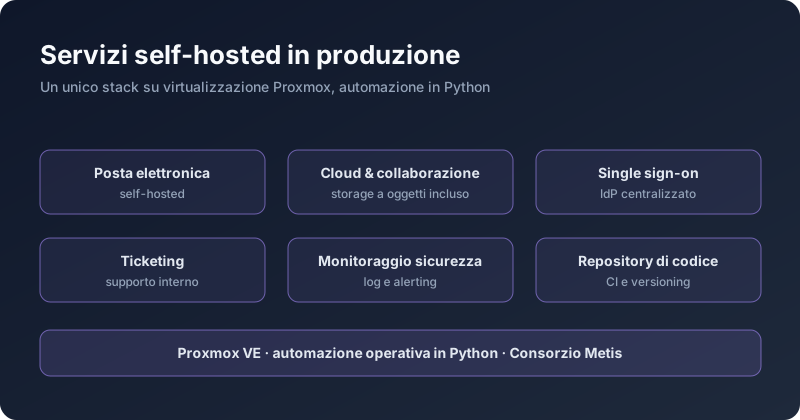
Professional experience as an employee at Consorzio Metis. The stack is described by category, without identifying details.
Context
Self-hosting company services — instead of outsourcing them to external SaaS — brings control over data and costs, but shifts the full responsibility for availability, security and updates onto the administrator. The difference between a service fleet that works and one that wears the team down is operational method.
What it covers
- Self-hosted email, cloud storage and collaboration, object storage.
- Centralized single sign-on / Identity Provider: one identity for every service.
- Ticketing for internal support and code repositories with versioning.
- Security monitoring: log collection, alerting, event visibility.
- All on Proxmox VE virtualization, with repetitive operational processes automated in Python.
Technical challenges
Heterogeneous lifecycles. Every service has its own release cadence, breaking changes and maintenance windows: running more than ten in production requires a disciplined update process — staging, backups, rollbacks at the ready.
SSO as the backbone. Centralizing identity simplifies users’ lives but makes the IdP a critical component: its availability and the correctness of its integrations (OIDC/SAML) affect every other service.
Automation as hygiene. Repetitive tasks — provisioning, checks, reporting — are automated in Python: fewer human errors, more time for work that requires judgment.
Stack
Proxmox VE · self-hosted services (mail, cloud, SSO/IdP, ticketing, security monitoring, Git) · Python